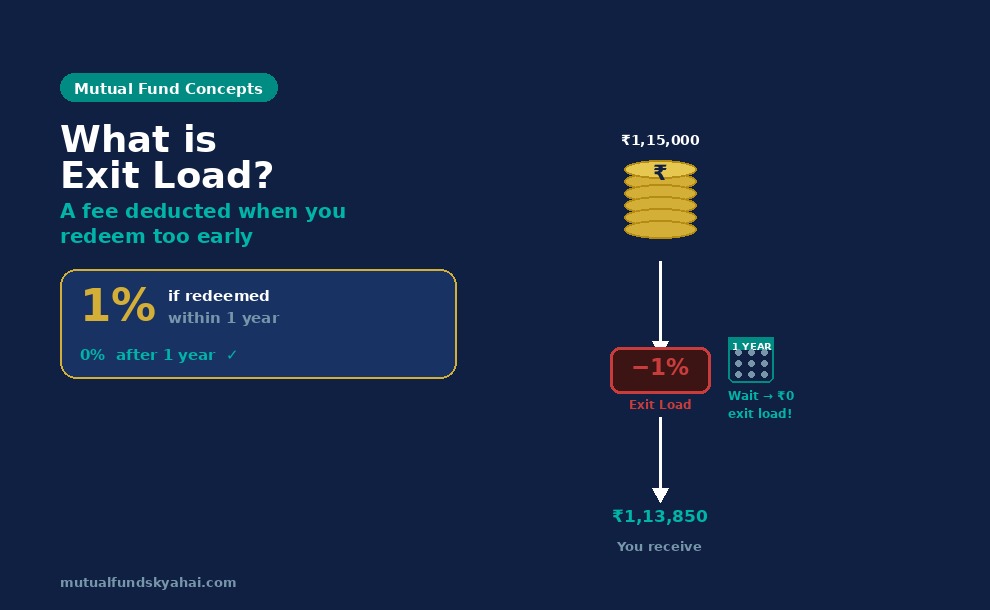
What is Exit Load in Mutual Funds?
When you invest in a mutual fund, you are free to redeem your units whenever you wish. However, if you exit too soon, the fund house may charge you a small fee — this is called an exit load. In simple terms, exit load is a percentage of your redemption amount that is deducted before the proceeds are credited to your bank account.
Exit load exists to discourage investors from withdrawing money prematurely. It protects long-term investors in the fund from the costs (like selling assets at unfavourable prices) that arise when other investors exit in a hurry.
In India, exit loads are governed by SEBI (Securities and Exchange Board of India) regulations. SEBI has capped exit load at a maximum of 2% for most mutual fund categories, and the collected exit load — after deducting fund management costs — is credited back to the scheme, benefiting remaining investors.
How Does Exit Load Work? A Step-by-Step Example
Imagine you invest ₹1,00,000 in an equity mutual fund that charges an exit load of 1% if redeemed within 1 year.
- You invest ₹1,00,000 at NAV of ₹100, receiving 1,000 units.
- After 8 months, the NAV rises to ₹115. You decide to redeem all 1,000 units.
- Gross redemption value = 1,000 × ₹115 = ₹1,15,000
- Exit load = 1% of ₹1,15,000 = ₹1,150
- Net amount credited to your account = ₹1,15,000 − ₹1,150 = ₹1,13,850
If you had waited just 4 more months (completing 1 year), you would have received the full ₹1,15,000 — saving ₹1,150 with no extra effort.
Exit load is calculated on the redemption value, not on your original investment. This is important because even your profits are subject to exit load if you exit early.
Which Mutual Funds Charge Exit Load?
Different categories of mutual funds have different exit load structures. Here is a general overview as commonly seen in India:
- Equity Funds (large cap, mid cap, flexi cap, ELSS, etc.): Typically 1% if redeemed within 1 year. After 1 year, nil exit load.
- Hybrid Funds (balanced advantage, aggressive hybrid, etc.): Usually 1% within 1 year; nil thereafter.
- Debt Funds (credit risk, dynamic bond, gilt funds, etc.): Varies widely — some charge 0.25%–1% if redeemed within 3–12 months; many have nil exit load.
- Liquid Funds: Most liquid funds charge a graded exit load for the first 7 days (typically 0.0070% on Day 1 tapering to 0.0045% on Day 6, and nil from Day 7 onward). After 7 days, no exit load.
- Overnight Funds: No exit load — these are designed for very short holding periods.
- Index Funds and ETFs: Most index funds have nil or very low exit load. ETFs are traded on stock exchanges, so exit load does not apply (brokerage charges apply instead).
Always check the fund's Scheme Information Document (SID) or Key Information Memorandum (KIM) for the exact exit load structure before investing.
Who Should Be Most Careful About Exit Load?
Exit load primarily affects investors who may need to exit early. You should pay close attention to exit load if:
- You are investing money that you might need back within 6–12 months.
- You are switching frequently between funds (STP or rebalancing) and the fund charges exit load on switches.
- You are investing in sectoral or thematic funds, which may have higher exit loads to prevent hot-money flows.
- You are using a Systematic Withdrawal Plan (SWP) from a fund that charges exit load on each withdrawal.
For long-term investors (3+ years in equity, 1+ year in hybrid), exit load rarely matters because most funds waive it after the specified period.
Key Things to Watch Out For
- Check the exit load period, not just the percentage: A 1% exit load within 1 year is very common. But some thematic or sectoral funds charge exit load for up to 3 years. Read the fine print.
- SIP redemptions follow FIFO: In a SIP (Systematic Investment Plan), when you redeem, units are redeemed in First-In-First-Out order. Your older instalments may be exit-load-free while recent instalments are still within the load period.
- Switches attract exit load: Switching from Fund A to Fund B within the same AMC is treated as a redemption from Fund A. Exit load applies if you are within the exit load window of Fund A.
- Direct vs Regular Plans: Both carry the same exit load structure — exit load is a fund-level charge, not plan-level.
- Tax implication interaction: If you pay exit load, it reduces your effective sale proceeds, which in turn reduces your taxable capital gain. Always factor both exit load and capital gains tax when evaluating early redemption.
How to Avoid Exit Load Legally
You do not need to avoid exit load by staying in a bad fund forever. Here are smart ways to manage it:
- Plan your investment horizon before investing. Match the fund's exit load period to your actual holding period.
- Use liquid or overnight funds for short-term parking. These have minimal or no exit load and are ideal for 1 day to 3 months.
- Wait out the exit load window. If you are close to the end of the exit load period (e.g., 11 months into a 1-year load), it often makes sense to wait one more month.
- Check before you switch. Before initiating an intra-AMC switch, check the exit load status of the source scheme.
Frequently Asked Questions
Is exit load refundable?
No. Exit load is a fee deducted at the time of redemption. It is non-refundable. However, as per SEBI rules, the collected exit load (net of fund management cost) is credited back to the scheme, benefiting remaining investors.
Does exit load apply to dividend payouts (IDCW)?
No. Exit load applies only when you redeem (sell) your units. Dividend or IDCW payouts do not attract exit load because you are not redeeming units — the fund distributes income while you continue to hold units.
Can a fund change its exit load policy?
Yes, but with restrictions. A fund house can increase exit load only for prospective investments (new inflows after the change date). Existing investors who invested before the change are protected from the higher exit load on their existing units for at least 30 days from the date of notice.
What is the difference between entry load and exit load?
Entry load (charged at the time of purchasing units) was banned by SEBI in August 2009. Today, no mutual fund in India charges an entry load. Exit load continues to exist as a tool to discourage premature redemptions.