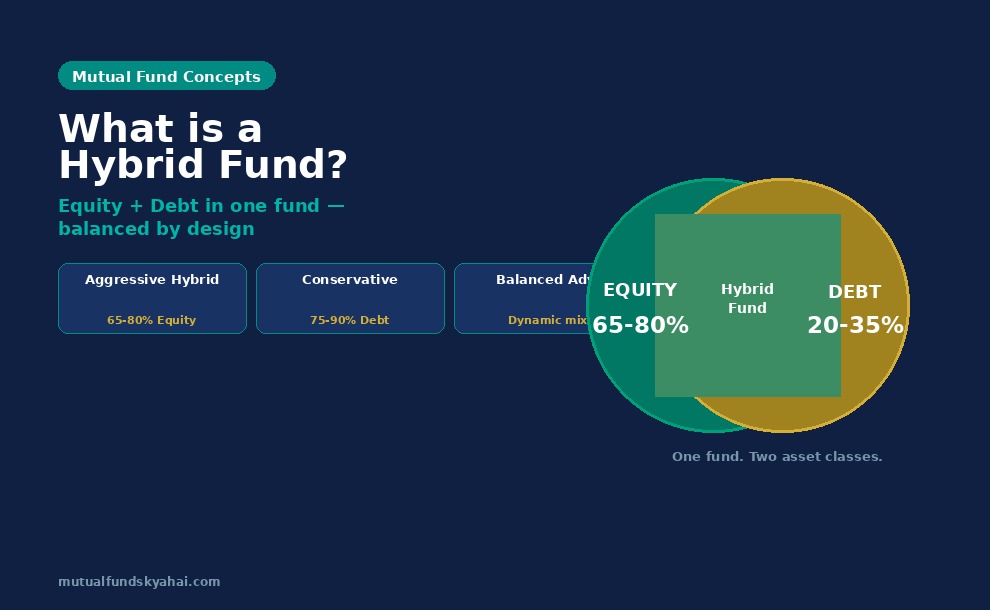
What is a Hybrid Fund?
A hybrid fund is a type of mutual fund that invests in more than one asset class — typically a mix of equity (stocks) and debt (bonds and fixed-income instruments). Instead of going all-in on either equities or debt, a hybrid fund blends the two, aiming to offer investors the growth potential of equities alongside the stability of debt.
Think of it this way: equity offers higher long-term returns but comes with market volatility, while debt provides steadier income but with lower growth. A hybrid fund sits in between — giving you a single, professionally managed product that handles both.
SEBI (Securities and Exchange Board of India) has formally defined and categorised hybrid mutual funds to ensure clarity for investors. Today, there are several distinct sub-categories, each with its own equity-debt allocation range.
How Does a Hybrid Fund Work?
When you invest in a hybrid fund, the fund manager allocates your money across equities and debt according to the fund's stated mandate. For example, an Aggressive Hybrid Fund must hold 65%–80% in equities and 20%–35% in debt at all times. A Conservative Hybrid Fund does the opposite — 75%–90% in debt with only 10%–25% in equities.
The fund manager also rebalances the portfolio periodically. If the equity portion grows too large due to a bull market, some equity may be sold and the proceeds moved into debt — automatically booking partial profits and managing risk. This disciplined rebalancing is one of the key benefits of hybrid funds for retail investors who may not do this themselves.
Here is a simplified example:
- You invest ₹1,00,000 in an Aggressive Hybrid Fund.
- The fund manager puts ₹70,000 in large-cap stocks and ₹30,000 in corporate bonds.
- Over a year, equities rise and the equity portion becomes ₹85,000. The manager rebalances — sells ₹10,000 of equity and buys more debt — bringing the ratio back to 75:25.
- Your portfolio grew, and risk was kept in check, without you having to do anything.
Types of Hybrid Funds in India
SEBI has defined six main categories of hybrid funds. Each suits a different investor profile:
- Conservative Hybrid Fund: 10%–25% equity, 75%–90% debt. Suited for investors who want mostly stable income with a small equity kicker. Low-to-moderate risk.
- Balanced Hybrid Fund: 40%–60% in both equity and debt. The fund cannot use arbitrage to boost returns. Moderate risk.
- Aggressive Hybrid Fund: 65%–80% equity, 20%–35% debt. The most popular hybrid category in India. Moderate-to-high risk. Equity taxation applies.
- Dynamic Asset Allocation / Balanced Advantage Fund (BAF): No fixed allocation — the fund manager actively shifts between equity and debt based on market valuations (often using PE ratio models). Moderate risk with a smoother ride than pure equity.
- Multi Asset Allocation Fund: Invests in at least three asset classes (e.g., equity, debt, and gold), each with a minimum 10% allocation. Good diversification across asset types.
- Arbitrage Fund: Uses arbitrage opportunities between the cash and futures markets. Returns are similar to liquid funds, but taxed as equity. Suited for short-term parking in the 3–12 month range for investors in higher tax brackets.
Who Should Consider a Hybrid Fund?
Hybrid funds work well for a wide range of investors, but they are especially suitable for:
- First-time equity investors who want market exposure but are not comfortable with 100% equity volatility. An Aggressive Hybrid Fund is a gentler entry point than a pure equity fund.
- Investors with a 3–5 year horizon who want better returns than fixed deposits but with lower risk than pure equity funds.
- Retirees or near-retirees who need capital preservation with some growth — a Conservative Hybrid Fund fits well here.
- Investors who struggle with rebalancing — hybrid funds do it automatically through the fund manager.
- Investors in Balanced Advantage Funds can benefit during volatile markets as the dynamic allocation reduces equity exposure when markets are expensive.
Key Things to Watch Out For
- Understand the tax treatment: If a hybrid fund holds 65% or more in equity, it is taxed like an equity fund — short-term capital gains (STCG) at 20% and long-term capital gains (LTCG) at 12.5% above ₹1.25 lakh per year. If equity is below 65%, debt fund taxation applies.
- Don't confuse categories: "Balanced Fund" is a loosely used term. Always check the SEBI category — Aggressive Hybrid, Conservative Hybrid, and Balanced Advantage are very different products.
- Exit load applies: Most hybrid funds charge 1% exit load if redeemed within 1 year. Plan your holding period accordingly.
- Check the equity allocation range: In a Balanced Advantage Fund, equity can move from near-0% to near-100% depending on the model used. Different AMCs use different valuation models — understand the approach before investing.
- Expense ratio matters: Hybrid funds tend to have slightly higher expense ratios than plain index funds. Compare the expense ratios of Direct vs Regular plans.
Frequently Asked Questions
Is a hybrid fund better than a pure equity fund?
Not necessarily better — different for different goals. A hybrid fund is less volatile than a pure equity fund because the debt component cushions market falls. But over a long horizon (10+ years), a pure equity fund may deliver higher returns. Hybrid funds are ideal for medium-term goals (3–7 years) or for investors who need to sleep better during market downturns.
Can I do a SIP in a hybrid fund?
Yes, absolutely. SIP (Systematic Investment Plan) works in hybrid funds just like in any other mutual fund. A monthly SIP in an Aggressive Hybrid Fund is a popular way for new investors to start their equity journey with built-in debt cushioning.
What is the difference between a Balanced Advantage Fund and an Aggressive Hybrid Fund?
An Aggressive Hybrid Fund always maintains 65%–80% in equity, regardless of market conditions. A Balanced Advantage Fund (BAF), on the other hand, dynamically adjusts its equity allocation based on market valuations — it may reduce equity to 30%–40% when markets are expensive and increase it when markets are cheap. BAFs are designed to reduce the emotional burden on investors during volatile markets.
Are hybrid funds safe?
No mutual fund is entirely "safe" in the sense of guaranteed returns. However, hybrid funds carry lower risk than pure equity funds because of their debt component. Conservative Hybrid Funds and Arbitrage Funds carry very low risk. Aggressive Hybrid Funds carry moderate-to-high risk. Always match the fund type to your own risk tolerance.