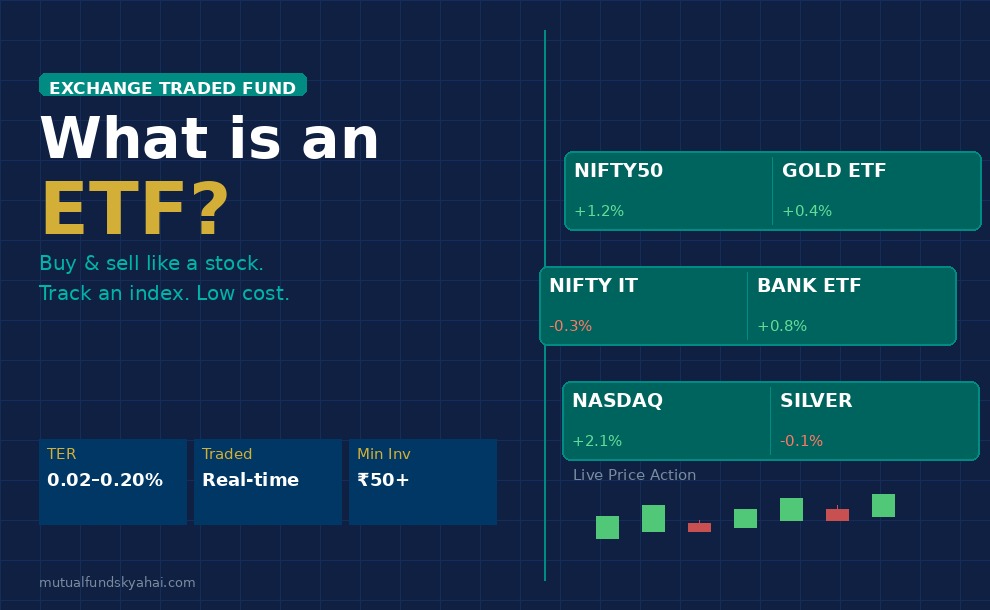
What is an ETF (Exchange Traded Fund)?
An Exchange Traded Fund, or ETF, is a type of investment fund that is listed and traded on a stock exchange — just like a company's shares. An ETF typically tracks an underlying index (such as Nifty 50 or Sensex), a commodity (like gold), or a basket of assets, and attempts to replicate its performance.
In India, ETFs were introduced by the Securities and Exchange Board of India (SEBI) and have grown rapidly in popularity, especially after the Employees' Provident Fund Organisation (EPFO) began investing in them from 2015 onwards.
Unlike a traditional mutual fund — where you buy and sell units at the end-of-day NAV — an ETF can be bought and sold throughout the trading day at real-time market prices through your Demat account and a stockbroker.
How Does an ETF Work?
Here is a simple step-by-step explanation of how an ETF functions:
- Creation: An Asset Management Company (AMC) buys a basket of securities (e.g., all 50 stocks in Nifty 50 in the same proportion). These securities are held by the fund's custodian.
- Listing: The ETF units are listed on a stock exchange (NSE or BSE). You can buy or sell them during market hours, just like buying shares of any listed company.
- Price Discovery: The market price of an ETF unit fluctuates during the day based on supply and demand, but stays very close to its iNAV (Indicative NAV) — the real-time value of its underlying holdings.
- Example: If the Nifty 50 ETF has an iNAV of ₹200 and the Nifty 50 index rises 1% during the day, the ETF price moves to approximately ₹202.
To buy an ETF, you need a Demat account and a trading account with a SEBI-registered broker (such as Zerodha, Groww, or ICICI Direct). ETF units are held in your Demat account, exactly like stocks.
Types of ETFs Available in India
India's ETF market has expanded significantly over the past decade. The main categories include:
- Equity ETFs: Track stock market indices. Examples: Nifty 50 ETF, Nifty Next 50 ETF, Nifty Bank ETF, Nifty Midcap 150 ETF.
- Gold ETFs: Track the domestic price of physical gold. One unit is approximately equal to 1 gram of gold — ideal for investors seeking inflation protection without storing physical gold.
- Debt ETFs: Track bond indices. Examples: Bharat Bond ETF (invests in PSU bonds with fixed maturity dates). Suitable for conservative, income-seeking investors.
- International ETFs: Provide exposure to global markets. Examples: Motilal Oswal Nasdaq 100 ETF, Mirae Asset NYSE FANG+ ETF.
- Sectoral / Thematic ETFs: Track specific sectors such as banking, IT, pharma, or infrastructure.
- Silver ETFs: Introduced in India in 2021, these track the price of silver — similar in structure to gold ETFs.
ETF vs Index Fund — What is the Difference?
Both ETFs and index funds track the same underlying index, but there are key differences in how you invest:
- Trading: ETFs are traded on exchanges in real time; index funds are bought or sold at end-of-day NAV only.
- Demat Account: ETFs require a Demat account; index funds do not.
- Minimum Investment: ETFs can be bought for the price of a single unit (sometimes as low as ₹50–₹100 for popular Nifty ETFs); index funds often have a ₹500 SIP minimum.
- SIP Facility: Index funds support easy SIPs via AMC platforms; ETFs require manual or broker-facilitated SIPs.
- Expense Ratio: ETFs generally have lower TERs (0.02%–0.20%) compared to index funds (0.10%–0.50%).
- Liquidity Risk: Thinly traded ETFs may have wide bid-ask spreads; index funds do not have this issue.
For most retail investors doing regular SIPs, index funds are simpler. For lump-sum investors comfortable with a Demat account and who want the lowest possible costs, an ETF may be preferable.
Who Should Consider Investing in ETFs?
- Passive investors who want to match market returns rather than try to beat them
- Cost-conscious investors looking for the lowest expense ratios available
- Investors with a Demat account who are comfortable placing orders through a broker
- Institutional investors and HNIs making large lump-sum deployments efficiently
- Gold and silver investors who want commodity exposure without physically storing the metal
- Long-term investors with a 5–10 year horizon who want diversified index exposure at low cost
ETFs are generally not suitable for investors who prefer simplicity over cost savings, or who are not comfortable managing a Demat account and placing buy/sell orders independently.
Key Things to Watch Out For
- Liquidity: Always check the average daily traded volume of an ETF. Low-volume ETFs can have wide bid-ask spreads, meaning you may buy above iNAV or sell below it.
- Tracking Error: This measures how closely the ETF follows its benchmark index. A lower tracking error is better. Check it in the fund's monthly factsheet.
- Transaction Costs: While TER may be lower, you pay brokerage, STT (Securities Transaction Tax), and exchange charges on every trade. Factor these in, especially for small or frequent purchases.
- No Easy SIP Automation: Unlike regular mutual funds, setting up a fully automated SIP in an ETF requires additional effort or a broker platform that supports it.
- SEBI Regulations: SEBI mandates that AMCs disclose the daily portfolio, iNAV, and tracking error of all ETFs. Always review these disclosures before investing.
Frequently Asked Questions
Q: Can I start an SIP in an ETF? A: Yes, but it requires more effort. Some brokers (like Zerodha) offer ETF SIP features. Alternatively, you can manually place buy orders on a fixed date each month. For hassle-free SIPs, index funds remain simpler.
Q: Is an ETF safer than investing in a direct stock? A: Generally yes. An equity ETF holds a basket of dozens or hundreds of stocks, so any single company's poor performance has a limited impact on the overall fund. However, ETFs still carry full market risk.
Q: How are ETF gains taxed in India? A: For equity ETFs held more than 12 months, Long-Term Capital Gains (LTCG) above ₹1.25 lakh per year are taxed at 12.5%. Short-term gains (held less than 12 months) are taxed at 20%. Debt ETFs are taxed as per the investor's income tax slab, regardless of the holding period.
Q: What is the minimum amount needed to invest in an ETF? A: You can buy as little as 1 unit of an ETF. Depending on the ETF, this can range from ₹50 (for popular Nifty 50 ETFs) to several thousand rupees (for gold or international ETFs).