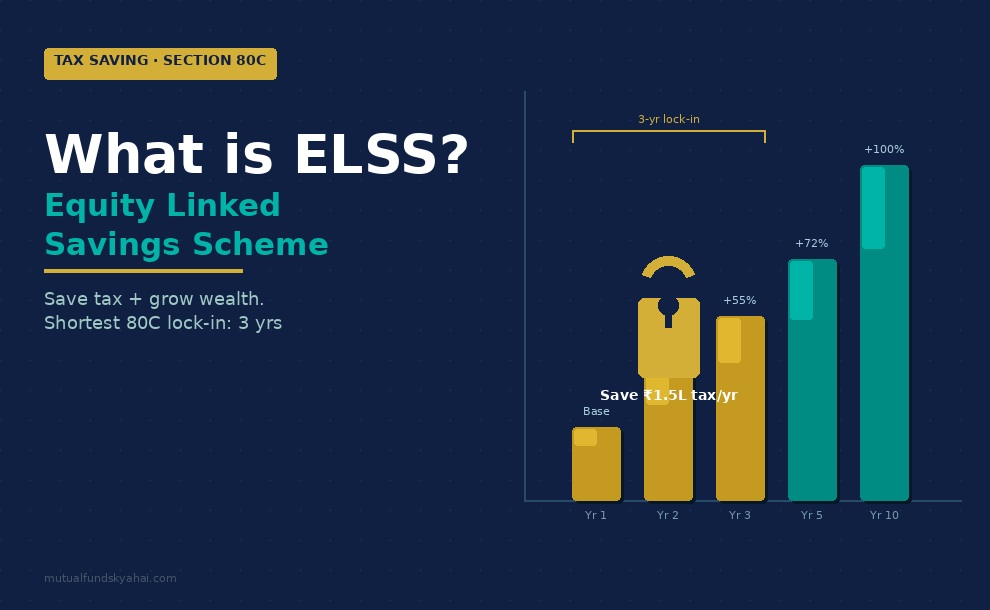
Every year, as the financial year-end approaches, millions of Indian investors scramble to find tax-saving investments under Section 80C of the Income Tax Act. Among all the options — PPF, NSC, ULIP, tax-saving FDs — one stands out for its potential to both save tax and build real wealth over time: ELSS, the Equity Linked Savings Scheme.
What is ELSS?
ELSS stands for Equity Linked Savings Scheme. It is a category of mutual fund that invests primarily in equity (stocks) and qualifies for a tax deduction of up to ₹1.5 lakh per year under Section 80C of the Income Tax Act, 1961. Unlike most other 80C instruments, ELSS comes with the shortest lock-in period — just 3 years — and the highest potential for long-term wealth creation.
SEBI mandates that ELSS funds invest at least 80% of their assets in equity and equity-related instruments. The remaining portion may be in debt or cash. Fund managers have flexibility to invest across market caps — large-cap, mid-cap, and small-cap stocks — making ELSS a diversified equity investment with a tax benefit attached.
How Does the Tax Benefit Work?
When you invest in ELSS, the amount you invest (up to ₹1.5 lakh in a financial year) is deducted from your taxable income under Section 80C. Here is a simple illustration:
- Your annual income: ₹10 lakh
- You invest ₹1.5 lakh in ELSS
- Taxable income reduces to ₹8.5 lakh
- Tax saved: approximately ₹46,800 (for someone in the 30% tax bracket, including cess)
Note: The tax deduction is available only under the old tax regime. If you have opted for the new tax regime, ELSS investments do not reduce your tax liability — though they can still be good long-term equity investments.
The 3-Year Lock-In: What It Means
Every unit you purchase in an ELSS fund is locked in for exactly 3 years from the date of purchase. You cannot redeem or switch those units before 3 years. If you invest via SIP, each monthly instalment has its own 3-year lock-in from its respective purchase date.
After 3 years, you are free to redeem, stay invested, or continue adding more. Most financial advisors recommend staying invested beyond 3 years to let equity compounding do its full work — the lock-in is a floor, not a ceiling.
ELSS vs Other 80C Options
How does ELSS compare with other popular Section 80C instruments?
- PPF (Public Provident Fund): 15-year lock-in, ~7.1% fixed return, government-backed. Safe but slow. ELSS has a 3-year lock-in and historically delivered 12–15% CAGR over long periods, though with market risk.
- Tax-saving FD: 5-year lock-in, returns ~6–7%, fully taxable on maturity. ELSS has a shorter lock-in and better post-tax returns for long-term investors.
- NSC (National Savings Certificate): 5-year lock-in, ~7.7% fixed return. Safer but lower growth potential than ELSS.
- ULIP: 5-year lock-in, combines insurance and investment — generally has higher charges and lower flexibility than ELSS.
For investors with a 5+ year horizon and moderate-to-high risk tolerance, ELSS typically offers the best combination of tax saving, liquidity, and return potential among 80C options.
Who Should Invest in ELSS?
- Salaried professionals: Anyone wanting to exhaust their ₹1.5 lakh 80C limit efficiently, especially those in the 20% or 30% tax bracket under the old regime.
- Young investors: A 3-year lock-in encourages staying invested and reduces the temptation to redeem at market lows. It builds good investment discipline early.
- Long-term wealth builders: Those who want equity exposure with the added benefit of tax saving — and plan to stay invested well beyond the lock-in period.
- Not suitable for: Investors who need liquidity within 3 years, those who have opted for the new tax regime, or those with very low risk tolerance.
Key Things to Watch Out For
- Market risk applies: ELSS invests in equities. Your returns are not guaranteed and can be negative in the short term. Do not invest money you may need within 3 years.
- LTCG tax on redemption: Gains from ELSS above ₹1.25 lakh per year are taxed at 12.5% as Long-Term Capital Gains (LTCG). Plan redemptions accordingly to manage tax efficiently.
- SIP instalments have separate lock-ins: If you invest ₹5,000/month via SIP, the January instalment unlocks in January three years later — not all at once. This means you cannot redeem the full corpus on a single date.
- Choose based on long-term track record: Look at 5- and 10-year returns, not just the past 1 year. Consistency across market cycles matters more than recent performance.
Frequently Asked Questions
Can I invest more than ₹1.5 lakh in ELSS?
Yes. The ₹1.5 lakh limit is for the tax deduction under 80C. You can invest any amount in ELSS as a mutual fund — the excess beyond ₹1.5 lakh simply does not get the 80C deduction but remains a regular equity investment with no lock-in.
Is ELSS available for NRIs?
Yes, most ELSS funds are open to NRIs (Non-Resident Indians), subject to the fund house's KYC and FEMA guidelines. NRIs can invest on a repatriable or non-repatriable basis.
Should I invest in ELSS as a lump sum or SIP?
Both work. SIP is preferred for most investors as it averages out the purchase cost across market cycles (rupee cost averaging). Lump sum investment near market lows can be rewarding but requires timing judgment. A mix of both is also a valid approach.
What happens to my ELSS after the 3-year lock-in?
Nothing changes automatically — your units remain invested and continue to grow. You have the option to redeem whenever you choose. Many advisors recommend staying invested for 7–10 years or more to fully benefit from equity compounding.