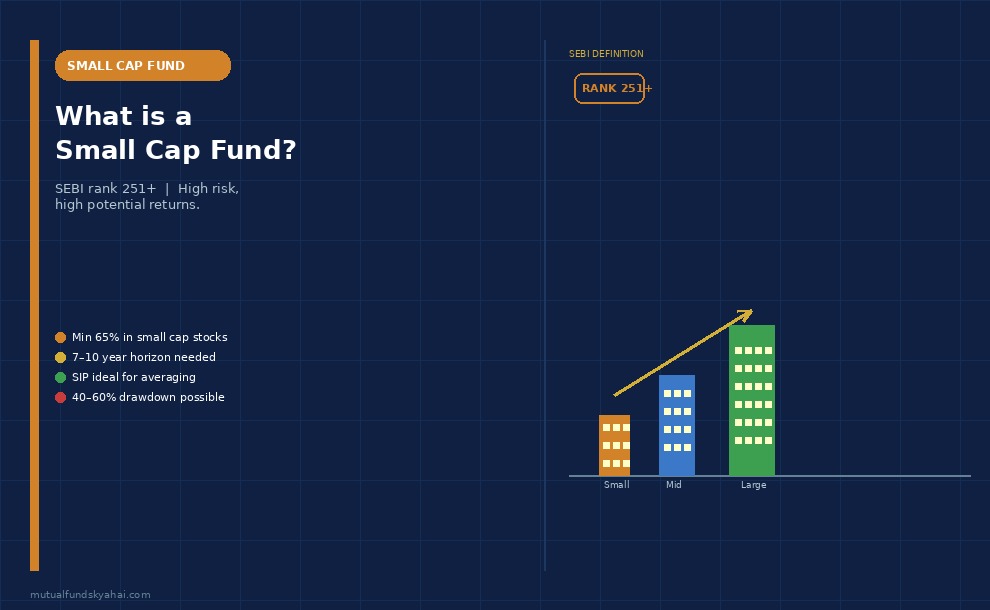
What is a Small Cap Fund?
A small cap fund is a type of equity mutual fund that primarily invests in the stocks of small cap companies — businesses ranked 251st and beyond by market capitalisation on Indian stock exchanges, as defined by SEBI. These are typically emerging, fast-growing companies still building their market position and brand.
In India, small cap stocks span sectors such as specialty chemicals, auto ancillaries, consumer durables, textiles, and IT services. While these companies may not be household names today, some of them grow into tomorrow's large caps — and early investors benefit significantly from that journey.
SEBI mandates that small cap funds invest at least 65% of their total assets in small cap stocks. The remaining 35% can be deployed in other equity or debt instruments at the fund manager's discretion.
How Does a Small Cap Fund Work?
When you invest in a small cap fund, your money is pooled with that of other investors and deployed into a diversified basket of small cap stocks by a professional fund manager. The manager researches companies with strong fundamentals, competitive advantages, and high growth potential — often before the broader market has discovered them.
The value of your investment fluctuates daily based on the fund's NAV (Net Asset Value), which depends on the market prices of the underlying stocks.
A simple example: Suppose a small cap company is currently valued at ₹500 crore. If it grows into a ₹5,000 crore mid-cap company over seven years, its stock price would have multiplied tenfold. A mutual fund holding a meaningful stake from early on would deliver exceptional returns to its investors — subject to the quality of the overall portfolio and market conditions.
However, the flip side is equally sharp. Small cap stocks can lose 40–60% of their value in a market downturn, and recovery can take years. This makes patience and a long investment horizon absolutely essential.
Small Cap Funds vs Mid Cap and Large Cap Funds
Understanding how small cap funds compare with their peers helps set expectations:
- Large Cap Funds: Invest in the top 100 companies by market cap. Relatively stable, lower risk, moderate returns.
- Mid Cap Funds: Invest in companies ranked 101–250 by market cap. Moderate risk and return — a middle ground between stability and growth.
- Small Cap Funds: Invest in companies ranked 251 and beyond. Highest potential returns but also the highest volatility and risk.
Small cap funds have historically outperformed large and mid cap funds over long periods — but with significantly steeper drawdowns during corrections. For example, during the 2020 COVID crash, many small cap indices fell over 40% within weeks, while large cap indices recovered much faster.
Who Should Consider Investing in a Small Cap Fund?
Small cap funds are suitable for a specific investor profile. Ask yourself these questions before investing:
- Long investment horizon: Are you comfortable staying invested for at least 7–10 years? Small caps need time to deliver. Short-term investors often exit at a loss during corrections.
- High risk tolerance: Can you absorb a 40–50% fall in portfolio value without panic-selling? If market volatility disturbs your peace of mind, small cap funds may not be the right fit.
- Existing equity base: Small cap funds work best as a satellite allocation — say 10–20% of your equity portfolio — alongside stable large cap or flexi cap funds at the core.
- Disciplined SIP investor: Investing via SIP in small cap funds is a proven strategy. Regular investments during market dips average down your cost and improve long-term returns significantly.
If you are a first-time investor or approaching retirement, it is generally better to start with large cap or balanced advantage funds before venturing into small caps.
Key Things to Watch Out For
- Liquidity risk: Small cap stocks are thinly traded. During market stress, fund managers may struggle to sell holdings at fair prices, hurting NAV. Always check the fund's AUM — a very large small cap fund may face liquidity challenges in volatile markets.
- Higher expense ratio: Active management of small cap portfolios requires more research. Compare expense ratios across funds — the difference between 0.5% and 1.5% can meaningfully impact long-term returns.
- Avoid chasing recent top performers: Small cap funds that top the charts in a bull run often underperform in the next cycle. Look at 5–7 year rolling returns, not just one-year rankings.
- Exit load: Most small cap funds levy a 1% exit load if you redeem within one year. Factor this in before investing short-term money.
- SEBI-mandated stress test disclosures: SEBI now requires small and mid cap funds to disclose how many days it would take to liquidate 25% and 50% of their portfolio. Review this before investing — funds with poor liquidity scores carry higher redemption risk during market downturns.
Frequently Asked Questions
What is the SEBI definition of a small cap company in India?
According to SEBI, small cap companies are those ranked 251st and beyond by full market capitalisation. The list is updated twice a year by AMFI based on the latest market cap data. There is no fixed rupee cut-off — a company classified as small cap today may graduate to mid cap or large cap as it grows.
Are small cap funds safe for long-term investment?
Small cap funds carry higher volatility and risk compared to large and mid cap funds. However, for investors with a 7–10 year horizon and a high risk appetite, they can generate superior wealth over time. The key is staying invested through market cycles rather than exiting during corrections. SIP investments help manage timing risk effectively.
How much of my portfolio should I allocate to small cap funds?
Financial advisors typically recommend keeping small cap exposure between 10% and 25% of total equity allocation, depending on your age and risk tolerance. Younger investors with longer time horizons can take on higher exposure. As you approach your financial goal, gradually reducing small cap allocation and shifting to more stable instruments is a prudent strategy.
What is the difference between a small cap fund and a small cap index fund?
An actively managed small cap fund has a fund manager selecting stocks based on research and judgment, aiming to outperform the benchmark. A small cap index fund passively tracks an index like the Nifty Smallcap 250, with lower expense ratios. Unlike the large cap space where index funds often win, several active small cap funds in India have consistently beaten their benchmarks over the long term — making active management more relevant in this category.