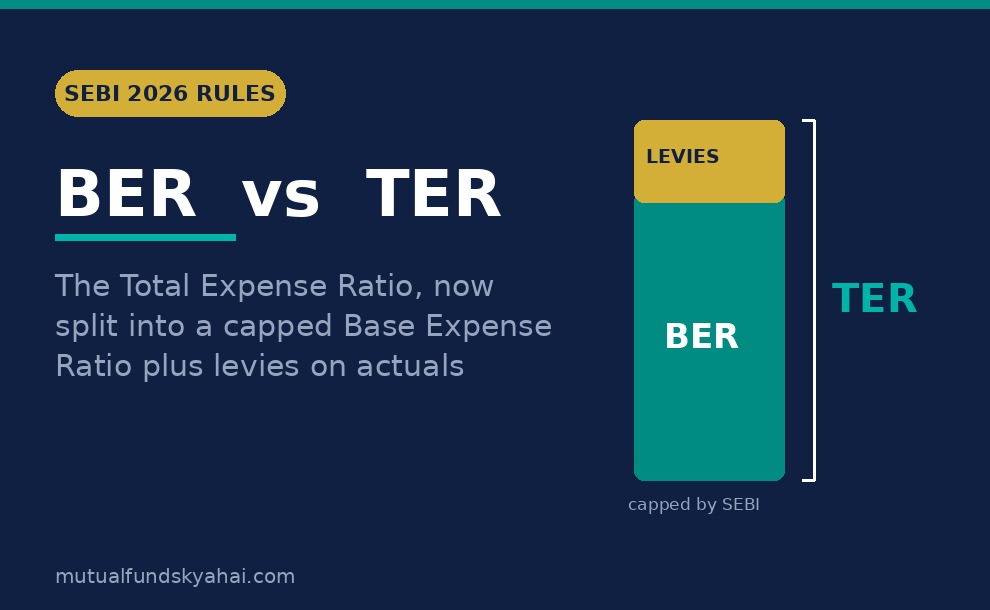
What is the Base Expense Ratio (BER)?
The Base Expense Ratio (BER) is the core, controllable cost of running a mutual fund scheme — essentially the fund manager's investment management fee, distribution or commission costs, and day-to-day operating and administrative expenses. It is expressed as a percentage of the scheme's daily net assets and is the number that market regulator SEBI now caps directly through its Assets Under Management (AUM) slab structure.
Crucially, the BER leaves out taxes and statutory charges. Under the SEBI (Mutual Funds) Regulations, 2026, the Base Expense Ratio excludes levies such as Goods and Services Tax (GST), Securities Transaction Tax (STT), Commodity Transaction Tax (CTT), stamp duty, SEBI fees, and exchange charges. This makes the BER a clean, apples-to-apples measure of what an Asset Management Company (AMC) actually charges to manage your money.
What is the Total Expense Ratio (TER)?
The Total Expense Ratio (TER) is the all-in annual cost you bear as an investor, again shown as a percentage of the scheme's average Net Asset Value (NAV). The daily NAV you see is already net of these expenses — they are deducted quietly before the NAV is published, so you never receive a separate bill.
For years, TER was treated as a single headline number that bundled very different things together: the manager's fee, distribution and operating costs, and a set of government taxes and statutory levies. The problem was that any change in a tax rate could inflate a fund's reported TER even if the fund house had done nothing differently — and two funds with identical management costs could show different TERs purely because of levy differences. SEBI's 2026 overhaul was designed to end this confusion.
How the New SEBI 2026 Framework Works
Effective 1 April 2026, SEBI redefined how expenses are presented. The Total Expense Ratio is no longer one opaque figure. Instead:
TER = Base Expense Ratio (BER) + brokerage + statutory / regulatory levies (charged on actuals)
The key shift is that statutory levies — STT, CTT, GST, stamp duty, SEBI fees and exchange charges — are now billed separately, on an actuals basis, rather than being buried inside the expense limit. The BER is what SEBI caps and what AMCs compete on; the levies are disclosed for what they truly are: government charges, not fund management fees.
One subtlety worth understanding: SEBI has clarified that TER is not simply BER plus a fixed levy figure added on top. Because the levies are variable and charged as actually incurred, the total you pay moves with real transaction activity and tax rates, while the BER stays predictable within its slab cap.
BER vs TER at a Glance
| Aspect | Base Expense Ratio (BER) | Total Expense Ratio (TER) |
|---|---|---|
| What it captures | Core fund-running cost: management fee, distribution, operating and admin expenses | Everything the investor bears: BER + brokerage + statutory levies |
| Includes taxes / levies? | No — GST, STT, CTT, stamp duty, SEBI and exchange charges are excluded | Yes — those levies are added on actuals, on top of BER |
| Regulated cap? | Yes — capped by SEBI's AUM slab structure | No single fixed cap; it moves with actual levies and brokerage |
| Stability | Predictable, fixed by slab | Variable — shifts if tax rates or transaction costs change |
| Purpose | Lets you compare true management cost across funds cleanly | Shows the full deduction actually taken from your returns |
What Changed in the Numbers
The 2026 rules did more than relabel things — they lowered costs. Maximum expense ratios were cut across AUM slabs, with reductions of up to 15 basis points, though most slabs see a 10-bps cut. Some concrete examples:
- The highest BER for open-ended equity schemes with AUM under ₹500 crore drops from 2.25% to 2.10%.
- The cap for index funds and ETFs falls from 1.00% to 0.90%.
- The cap for close-ended equity schemes drops from 1.25% to 1.00%.
- The additional 5-bps allowance that funds could charge in lieu of exit-load credits has been scrapped.
- Brokerage and transaction cost caps have been roughly halved.
Even a fraction of a percentage point compounds heavily over decades. On a ₹10,000 monthly SIP over 20 years at a 12% gross return, the gap between a very low-cost fund and a high-cost one can run into several lakhs of rupees — which is exactly why regulators keep tightening these limits.
What Investors Should Watch Out For
- Direct vs Regular plans still matter most. The single biggest cost lever in your control is choosing the Direct plan of a scheme, which strips out distributor commission and can save 0.5% to 1.5% a year versus the Regular plan.
- Beware churn advice. The reformed slabs give smaller and newer funds higher expense allowances than large, established ones. This creates a fresh incentive for some distributors to push you to switch funds unnecessarily. Do not move from a large, low-cost fund to a smaller one without a genuine reason.
- Read the BER, not just the TER. When comparing two funds, the BER is now the fairer number because it excludes tax noise you cannot control.
- Check disclosures. Fund houses must disclose expense ratios daily on their websites and factsheets — use these current figures rather than old brochures.
Frequently Asked Questions
Is a lower BER always better?
A lower BER means less cost drag, which helps long-term returns — but it should be weighed alongside the fund's strategy, consistency and risk. A slightly higher BER can be justified by genuine outperformance, though this is rare over long horizons.
Do I pay the TER separately?
No. Both BER and the associated levies are deducted from the scheme's assets before the daily NAV is declared. You never receive a separate invoice; the cost simply reduces your returns.
Why did SEBI separate levies from the BER?
To improve transparency and comparability. By ring-fencing the BER — the part AMCs actually control — investors can compare the true cost of management without tax changes distorting the picture, while government levies are shown honestly as separate charges.
When did these changes take effect?
SEBI's board approved the SEBI (Mutual Funds) Regulations, 2026 on 17 December 2025, and the new expense-ratio framework came into effect from 1 April 2026.