What Are Direct and Regular Mutual Fund Plans?
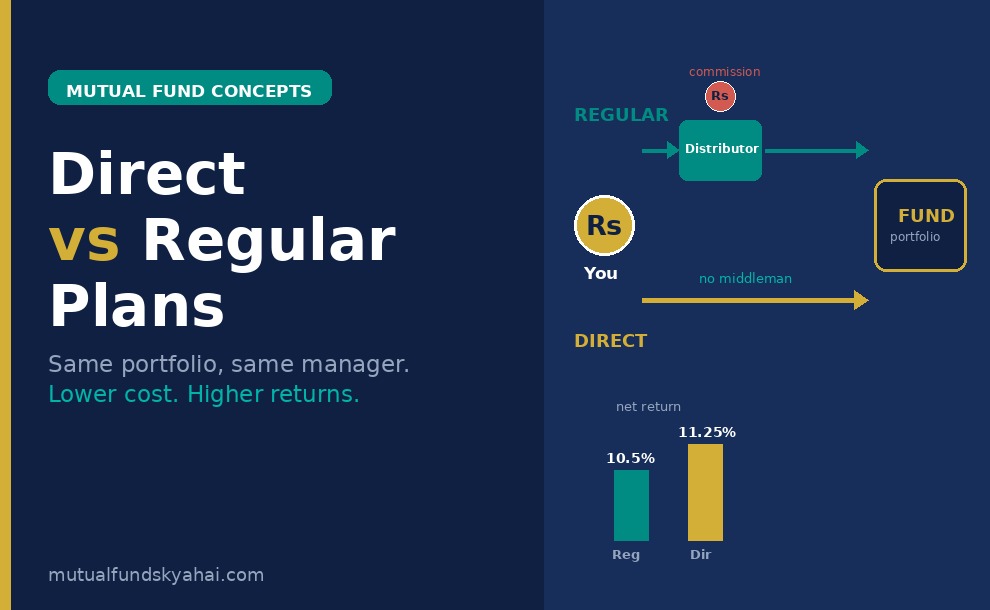
Every mutual fund scheme in India comes in two variants: a Direct plan and a Regular plan. Both invest in exactly the same portfolio, are run by the same fund manager, and follow the same investment objective. The only real difference is how you buy them — and, as a result, how much you pay in expenses each year.
A Regular plan is bought through an intermediary such as a mutual fund distributor, bank, or advisor. The fund house pays that intermediary a commission (called a trail commission) for bringing in and servicing your investment, and this cost is built into the plan's expense ratio.
A Direct plan is bought straight from the Asset Management Company (AMC) or through platforms that charge no commission. Since there is no distributor to pay, the expense ratio is lower. SEBI made direct plans mandatory for every scheme from 1 January 2013.
How the Difference Actually Affects Your Returns
Because a direct plan carries no distributor commission, its expense ratio is typically 0.5% to 1% lower per year than the regular plan of the same scheme. That gap sounds small, but it compounds heavily over time.
Consider an example where both plans generate 12% gross annual returns before costs:
- Regular plan with a 1.5% expense ratio → net return of about 10.5%
- Direct plan with a 0.75% expense ratio → net return of about 11.25%
Invest ₹10,000 a month for 20 years. At 10.5% the corpus is roughly ₹86 lakh; at 11.25% it grows to about ₹95 lakh — a difference of nearly ₹9 lakh, purely from the lower cost. This is exactly why the direct plan of any scheme always shows a higher NAV than its regular plan.
Key Differences at a Glance
Expense ratio
Direct plans have a lower expense ratio because they exclude distributor commission. This is the single most important difference between the two.
NAV
The direct plan's Net Asset Value is always slightly higher than the regular plan's for the same scheme, reflecting the lower cost drag.
How you buy
Regular plans come via distributors, banks, and advisors. Direct plans are bought from the AMC website or office, RTA platforms (CAMS, KFintech), the MF Central portal, or commission-free investing apps.
Advice and hand-holding
With a regular plan, the commission pays for the distributor's guidance — scheme selection, paperwork, and ongoing service. With a direct plan you do the research and transactions yourself, or pay a SEBI-registered investment adviser a separate, transparent fee.
Who Should Consider Which Plan?
Direct plans suit investors who are comfortable choosing their own funds, tracking their portfolio, and completing transactions online. If you understand your goals and risk appetite and do not need hand-holding, the lower cost feeds straight into higher returns.
Regular plans suit investors who value personalised advice, prefer someone to handle paperwork and rebalancing, or are new to investing and want guidance. The commission is the price of that ongoing service — and good advice can be worth far more than the cost saved.
A sensible middle path is to use a fee-only SEBI Registered Investment Adviser (RIA), who recommends direct plans and charges a flat advisory fee instead of earning hidden commissions.
Key Things to Watch Out For
- Check the plan name. A scheme name will explicitly say "Direct" or "Regular". If it does not say Direct, it is a Regular plan.
- Switching triggers tax. Moving from a regular to a direct plan of the same scheme is treated as a redemption plus a fresh purchase, so capital gains tax and any exit load may apply.
- Do not chase cost alone. A cheap direct plan of a poorly chosen fund is worse than a well-chosen fund in either variant. Fund selection matters more than the expense difference.
- Free platforms are not advice. Commission-free apps offering direct plans usually give no personalised advice; you are responsible for your own choices.
- Compare like with like. When tracking returns, compare a direct plan against direct plan figures, not against regular plan numbers.
Frequently Asked Questions
Is a direct plan always better than a regular plan?
In pure cost terms, yes — direct plans have lower expense ratios and higher returns for an identical portfolio. But "better" depends on whether you can manage your own investments. If you need advice, a regular plan, or a fee-only adviser paired with direct plans, may serve you better.
Can I convert my regular plan into a direct plan?
Yes. You can switch online through the AMC or RTA, but it counts as a redemption and repurchase, so exit load and capital gains tax may apply. Weigh that one-time tax cost against the future savings.
Do direct and regular plans hold different stocks?
No. Both variants of a scheme hold exactly the same portfolio and are run by the same fund manager. Only the expense ratio and NAV differ.
Where can I buy direct plans in India?
Through the AMC's own website or office, RTA platforms such as CAMS and KFintech, the MF Central portal, or SEBI-registered commission-free investing apps.