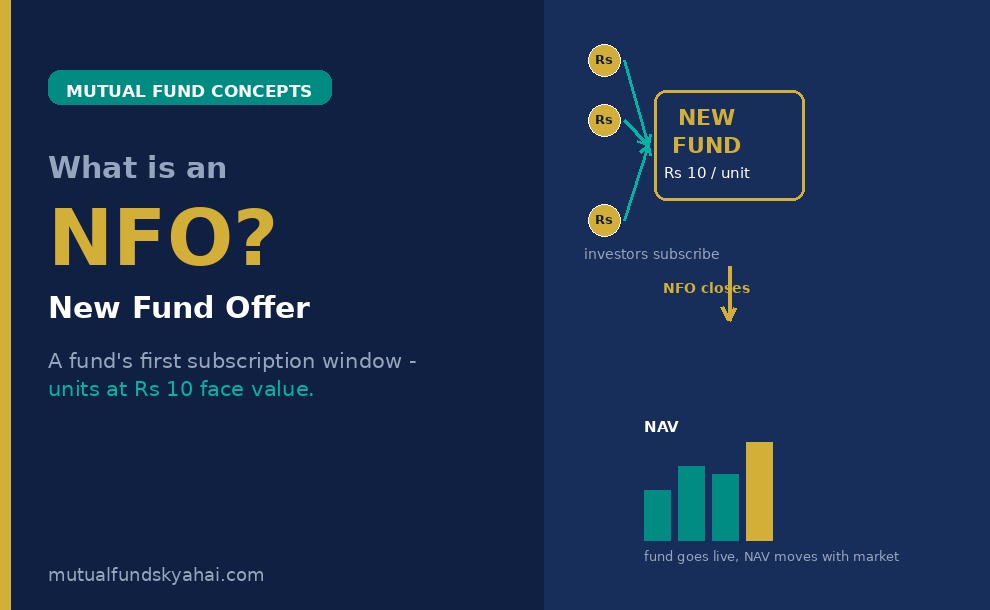
What is a New Fund Offer (NFO)?
A New Fund Offer, or NFO, is the first-ever subscription window through which a mutual fund house (AMC) launches a brand-new scheme and invites investors to put in money before the fund actually starts operating. Think of it as the mutual fund equivalent of a company's IPO — but instead of buying shares of a business, you are buying units of a newly created fund.
During an NFO, units are almost always offered at a fixed face value of ₹10 per unit. The offer stays open for a limited period (typically up to 15 days for open-ended funds, and up to 30 days as allowed by SEBI). Once the NFO closes, the fund manager begins investing the collected money as per the scheme's objective, and the fund reopens for regular buying and selling at its daily NAV.
How Does an NFO Work?
The journey of an NFO follows a clear sequence:
- Announcement: The AMC files a Scheme Information Document (SID) with SEBI and announces the new scheme, its objective, category, and fund manager.
- Subscription period: Investors apply during the open window, usually at ₹10 per unit. You can invest lump sum, and SIPs may also be offered.
- Allotment: After the NFO closes, units are allotted based on the amount you invested divided by ₹10.
- Fund goes live: The fund manager deploys the corpus into stocks, bonds, or other assets, and the scheme's NAV starts moving with the market.
For example, if you invest ₹50,000 in an NFO priced at ₹10, you receive 5,000 units. Once the fund is live and the NAV rises to, say, ₹11, your holding is worth ₹55,000.
Types of NFOs
Open-ended NFO
The most common type. After the NFO closes, the fund remains open for you to buy or redeem units at any time at the prevailing NAV. Most equity, debt, and hybrid funds fall here.
Close-ended NFO
Units are offered only during the NFO, and the fund has a fixed maturity (for example, three or five years). You cannot redeem freely before maturity; to exit early you must sell the units on the stock exchange, often at a discount.
Passive / thematic NFOs
Many recent NFOs are index funds, ETFs, or thematic/sectoral funds launched to capture a specific idea (say, a new index, a sector, or an international theme) not already covered by the AMC's existing line-up.
Who Should Consider an NFO?
An NFO makes sense when it offers something genuinely new that fits your goals — for instance, a passive index fund tracking an index no existing scheme covers, or a well-designed thematic fund that matches a view you already hold. Investors comfortable with a longer horizon and some uncertainty (since the fund has no track record) are better suited to NFOs.
If you simply want proven, consistent performance, an existing fund with a multi-year track record is usually the safer choice. There is no rule that a new fund will outperform established ones — often the opposite, because a new scheme has to build its portfolio from scratch.
Key Things to Watch Out For
- ₹10 is not "cheap". The biggest myth about NFOs is that a ₹10 unit is a bargain versus an existing fund trading at a ₹100 NAV. It is not. NAV only reflects the value per unit; a lower NAV does not mean better value or more room to grow.
- No track record. A new fund has no past performance to evaluate. You are relying entirely on the objective, the fund manager, and the AMC's pedigree.
- Ask what is genuinely new. If the AMC already runs a similar fund with a strong record, that existing fund is usually the better bet than an untested NFO.
- Check costs and lock-in. Review the expense ratio and any exit load. Close-ended NFOs lock your money until maturity, which reduces liquidity.
- Ignore the marketing push. NFOs are heavily promoted because they help AMCs gather assets. Judge the scheme on merit, not the advertising.
Frequently Asked Questions
Is investing in an NFO like buying an IPO?
Structurally it is similar — both are first-time offers at a fixed price. But an IPO share price is set by demand and company valuation, whereas an NFO unit is almost always ₹10 and simply represents a fresh, empty fund. A low NFO price carries none of the "listing gain" potential people associate with IPOs.
Is a ₹10 NFO cheaper than a fund with a ₹100 NAV?
No. This is the most common misconception. Both funds grow in percentage terms based on their underlying investments. A ₹10 NAV is not a discount — it just means the fund is new.
Can I exit an NFO whenever I want?
For open-ended NFOs, yes — you can redeem at NAV once the fund reopens, subject to any exit load. Close-ended NFOs lock your money until maturity, though the units may be listed on an exchange for early sale.
How is NFO allotment priced?
Units are allotted at the ₹10 face value. Your invested amount divided by ₹10 gives the number of units you receive.