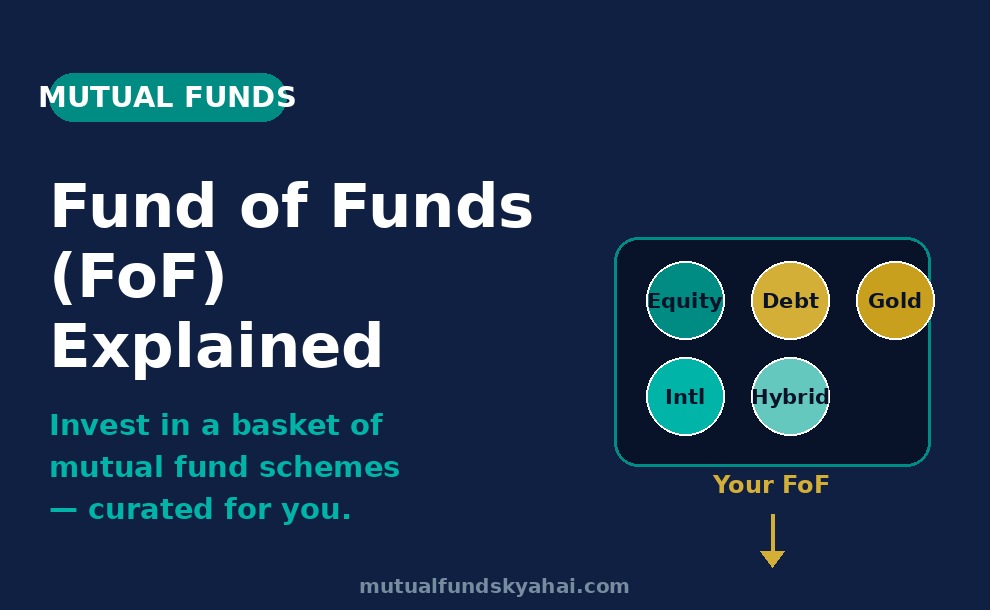
What is a Fund of Funds (FoF)?
A Fund of Funds (FoF) is a type of mutual fund that invests in other mutual fund schemes rather than directly buying stocks, bonds, or other securities. Instead of picking individual companies or debt instruments, the fund manager of a FoF selects a basket of existing mutual fund schemes to invest in — making it a "fund of funds."
Think of it this way: if a regular equity mutual fund is a restaurant that cooks its own food, a Fund of Funds is a food delivery platform that picks from the best restaurants in town. The platform does not cook itself — it curates. Similarly, a FoF curates top-performing schemes on behalf of the investor.
In India, SEBI regulates Fund of Funds under the Mutual Funds Regulations and they are offered by most major Asset Management Companies (AMCs).
How Does a Fund of Funds Work?
When you invest ₹10,000 in a Fund of Funds, here is what happens step by step:
- Your money is pooled with other investors' money at the AMC level.
- The FoF's fund manager allocates this pool across several pre-selected mutual fund schemes.
- Each of those underlying schemes then invests in stocks, bonds, or other assets as per their own mandate.
- The NAV (Net Asset Value) of your FoF reflects the weighted performance of all the underlying schemes.
For example, an international FoF might invest 40% in a US equity fund, 30% in a European equity fund, and 30% in an emerging markets fund — giving you global diversification through a single Indian mutual fund investment.
Types of Fund of Funds in India
There are several varieties of FoFs available to Indian investors:
- Domestic FoF: Invests in Indian mutual fund schemes only. Example: a FoF that holds large-cap, mid-cap, and flexi-cap schemes from domestic AMCs.
- International / Overseas FoF: Invests in foreign mutual funds or ETFs. These give Indian investors exposure to US, European, or global markets without needing a foreign brokerage account. Example: funds that invest in Nasdaq 100 ETFs or global tech funds.
- Gold FoF: Invests in a Gold ETF. This lets investors buy gold in fund form without needing a Demat account.
- Multi-Manager FoF: Spreads investments across schemes managed by different AMCs, reducing the risk of relying on any single fund house's strategy.
- Asset Allocator FoF: Dynamically shifts between equity, debt, and gold funds based on market conditions — a ready-made balanced portfolio.
Who Should Consider a Fund of Funds?
A Fund of Funds suits investors who:
- Want global diversification without the complexity of a foreign brokerage account (international FoFs).
- Prefer a single-window solution for multi-asset or multi-manager exposure.
- Are new to investing and want professional curation without needing to track multiple schemes.
- Want exposure to gold without holding physical gold or managing a Demat account (Gold FoFs).
- Prefer automatic rebalancing without doing it themselves (Asset Allocator FoFs).
FoFs are generally suited for medium to long investment horizons of 3–7 years and above, depending on the type.
Key Things to Watch Out For
Before investing in a Fund of Funds, keep these points in mind:
- Double Layer of Expenses: A FoF charges its own expense ratio AND the underlying schemes charge theirs. The total cost can be higher than directly investing in individual schemes. Always check the Total Expense Ratio (TER) of both layers.
- Tax Treatment — Important Difference: As of current SEBI and income tax rules in India, all Fund of Funds (including equity-oriented FoFs) are taxed like debt funds. This means gains are added to your income and taxed at your applicable slab rate — regardless of how long you hold them. This is different from direct equity funds which attract lower long-term capital gains tax after one year. Always verify the latest tax rules before investing.
- Performance Dilution: Investing in a basket of funds means you get averaged performance. Your FoF will not match the best-performing fund in the basket, but it also will not match the worst.
- Overlap Risk in Domestic FoFs: If multiple schemes in a domestic FoF invest in similar large-cap stocks, your real diversification may be limited even though you hold many funds.
- Currency Risk in International FoFs: Returns from overseas FoFs are also affected by the INR/USD or INR/EUR exchange rate. A falling rupee helps returns; a strengthening rupee hurts.
Frequently Asked Questions
Q: Can I invest in a Fund of Funds through SIP? Yes. Just like any other mutual fund, you can invest in a FoF via Systematic Investment Plan (SIP) in monthly or quarterly instalments.
Q: Is a Fund of Funds the same as a multi-asset fund? No. A multi-asset fund directly buys stocks, bonds, and gold in one portfolio. A Fund of Funds buys other mutual fund schemes — it does not hold the underlying assets directly.
Q: Are international FoFs affected by SEBI's overseas investment limits? Yes. SEBI and RBI periodically set limits on how much Indian mutual funds can invest abroad in aggregate. When these limits are hit, AMCs may temporarily stop accepting new investments into their international FoFs. Check with your AMC for current availability.
Q: What is the minimum investment in a Fund of Funds? Most FoFs allow investments starting at ₹500–₹1,000 for SIPs and ₹1,000–₹5,000 as a lump sum, similar to other mutual fund schemes.