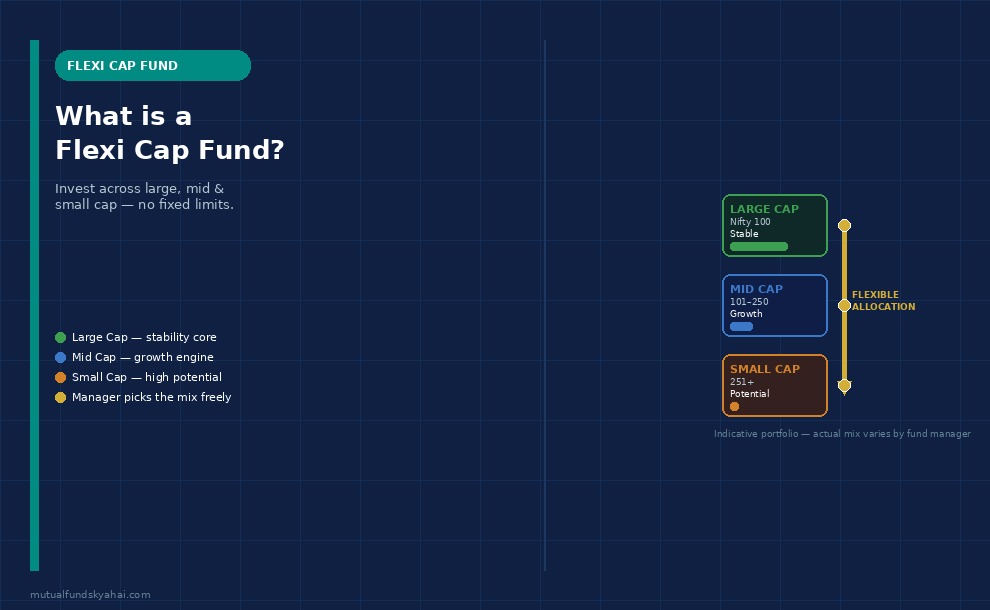
What is a Flexi Cap Fund?
A Flexi Cap Fund is an open-ended, diversified equity mutual fund that can invest across companies of any market capitalisation — large cap, mid cap, or small cap — without being constrained to a fixed allocation in each category. The fund manager has complete freedom to move money between market cap segments based on valuations, opportunities, and the prevailing market environment.
SEBI introduced the Flexi Cap category in November 2020 specifically to give fund managers this unconstrained flexibility. The only requirement is that the fund must invest at least 65% of its assets in equity and equity-related instruments — the split across large, mid, and small cap is entirely at the fund manager's discretion.
How Does a Flexi Cap Fund Work?
Unlike a large cap fund (which must invest at least 80% in the top 100 companies) or a mid cap fund (which must invest at least 65% in companies ranked 101–250 by market cap), a Flexi Cap Fund has no such restrictions. The fund manager can:
- Hold 80% in large caps when markets are expensive and large caps offer better risk-adjusted returns
- Shift to 50% mid cap and small cap when valuations in those segments are attractive
- Build a truly diversified portfolio across market caps simultaneously
This flexibility is the defining feature. A skilled fund manager can use it to reduce risk during volatile periods by moving into stable large caps, and capture growth during bull markets by increasing mid and small cap exposure.
Example: Suppose a Flexi Cap Fund currently holds 65% large cap, 25% mid cap, and 10% small cap. If the fund manager believes mid cap valuations have become attractive after a correction, they can shift to 55% large cap, 35% mid cap, and 10% small cap — without being forced to sell or buy anything to comply with a regulatory mandate.
Flexi Cap vs Multi Cap Fund — What is the Difference?
Many investors confuse Flexi Cap with Multi Cap funds. Here is the key distinction:
- Flexi Cap Fund: No minimum allocation to any market cap segment. The fund manager decides the mix entirely.
- Multi Cap Fund: SEBI mandates a minimum of 25% each in large cap, mid cap, and small cap — so at least 75% is always in a fixed split, with only 25% discretionary. This forces exposure to all three segments regardless of market conditions.
In practice, many Flexi Cap funds tend to be large-cap heavy (60–80%) since fund managers often prefer the liquidity and stability of large caps. Multi Cap funds, by contrast, guarantee meaningful mid and small cap exposure due to the regulatory minimum.
Types of Flexi Cap Fund Approaches
While all Flexi Cap funds share the same regulatory definition, fund managers adopt different styles in practice:
- Large-cap biased Flexi Cap: Most of the portfolio stays in large caps (70–80%) with selective mid/small cap positions for additional alpha. Lower risk, steadier returns.
- Truly diversified Flexi Cap: Actively manages the allocation mix, shifting meaningfully between market caps based on valuations. Requires more active management and conviction.
- Mid/small-cap tilted Flexi Cap: Some managers run a portfolio with 40–50% in mid and small caps to generate higher long-term returns. Higher risk, higher potential reward.
Before investing, check the fund's historical portfolio allocation across market caps — it reveals the fund manager's actual style far better than the fund category label alone.
Who Should Invest in a Flexi Cap Fund?
- First-time equity investors: A large-cap biased Flexi Cap fund is a good starting point — you get broad equity diversification without the volatility of a pure mid or small cap fund.
- Investors wanting a single equity fund: If you want just one equity fund, a well-managed Flexi Cap can serve as the core of your equity portfolio, as the fund manager handles the market cap allocation for you.
- Investors who trust active management: The Flexi Cap category rewards skilled fund managers. If you believe in the manager's ability to allocate wisely, this category lets them do their best work without regulatory constraints.
- Long-term investors (5+ years): The equity exposure means Flexi Cap funds can be volatile in the short term. They are best suited for investment horizons of 5 years or more.
Key Things to Watch Out For
- Check actual allocation, not just the label: A Flexi Cap fund that permanently holds 85% in large caps is essentially a large cap fund in disguise. Review the monthly portfolio statement to understand what you are actually getting.
- Fund manager dependency: The unconstrained nature of Flexi Cap funds means outcomes depend heavily on the fund manager's skill and judgment. A change in fund manager can meaningfully alter the fund's strategy and risk profile.
- Benchmark comparison is tricky: Because the allocation mix can change, comparing a Flexi Cap fund to a single benchmark (like Nifty 500) is imperfect. Look at rolling returns over 3, 5, and 7-year periods rather than just recent performance.
- Overlap with other equity funds: If you already hold a large cap fund and a mid cap fund separately, adding a large-cap biased Flexi Cap may create significant portfolio overlap. Review holdings before adding.
- Taxation: Flexi Cap funds are treated as equity funds for tax purposes. Gains held for more than 1 year are taxed at 12.5% LTCG (above ₹1.25 lakh). Gains within 1 year attract 20% STCG tax.
Frequently Asked Questions
Is a Flexi Cap Fund better than a Large Cap Fund?
Not necessarily — it depends on the fund manager's execution. A Flexi Cap fund has the potential to outperform a large cap fund over long periods by capturing mid and small cap growth at the right time. However, this potential comes with higher volatility and higher reliance on fund manager skill. A purely passive large cap index fund, by contrast, offers consistent, low-cost exposure to the top 100 companies without manager risk.
Can a Flexi Cap Fund become 100% large cap?
Technically yes — SEBI does not mandate any minimum allocation to mid or small cap. In practice, most fund managers maintain some mid and small cap exposure for diversification and return potential. Check the fund's investment mandate in its Scheme Information Document (SID) for any self-imposed allocation constraints.
How many Flexi Cap funds should I hold?
One or two well-chosen Flexi Cap funds is typically sufficient as the equity core of a portfolio. Holding more than two Flexi Cap funds usually creates unnecessary overlap without meaningful diversification benefit, since most will hold similar large cap stocks. Pair a Flexi Cap core with a focused mid or small cap fund if you want additional market cap exposure.
When did SEBI create the Flexi Cap category?
SEBI created the Flexi Cap Fund category in November 2020, separating it from the earlier Multi Cap category. Previously, funds that invested across market caps without fixed allocations were called Multi Cap funds. When SEBI mandated the 25-25-25 rule for Multi Cap in September 2020, it simultaneously created the Flexi Cap category to preserve the unconstrained mandate for fund managers who preferred it.