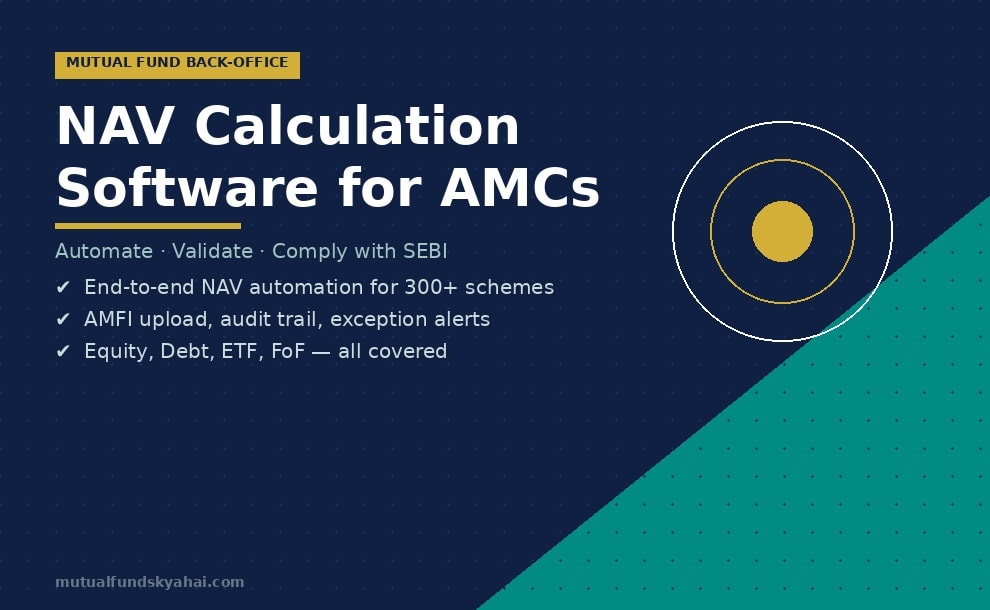
What is NAV Calculation in Mutual Funds?
Net Asset Value (NAV) is the per-unit price of a mutual fund scheme, declared every business day by all AMCs in India. SEBI mandates NAV declaration by 11 PM for most schemes and by 10 PM for liquid/overnight funds. An error or delay can attract regulatory penalties and erode investor trust.
NAV is calculated as: NAV = (Market Value of Assets – Liabilities) / Number of Outstanding Units
In practice, an AMC managing 50–300 schemes must perform this across equity, debt, hybrid, ETF, FoF, and other categories — each with its own valuation rules, accruals, loads, and tax implications. Manual processes are slow and risky.
Why Manual NAV Calculation Fails at Scale
- Volume: Large AMCs manage hundreds of schemes requiring data from exchanges, custodians, RTAs, and valuation agencies.
- Valuation complexity: Debt instruments require mark-to-market or amortisation-based valuation. Illiquid securities need committee-approved prices.
- Tight deadlines: SEBI timelines allow no room for manual reconciliation delays.
- Error propagation: A wrong security price cascades into wrong NAV, wrong unit allocation, and incorrect investor statements.
- Audit trail: Regulators require full traceability of every NAV calculation.
How Automated NAV Calculation Software Works
1. Data Ingestion
The software automatically pulls end-of-day data from NSE/BSE for equity prices, FIMMDA/SEBI feeds for debt securities, custodians for holdings and corporate actions, RTAs for unit capital and redemption data, and clearing corporations for settled trades.
2. Valuation Engine
The valuation module applies the correct methodology per security type: exchange closing price for equity, RBI/FIMMDA rates for G-Secs, SEBI-approved matrix pricing for corporate bonds, amortisation or YTM basis for money market instruments, and exchange settlement prices for derivatives.
3. Expense and Accrual Processing
Daily accruals for management fees, trustee fees, custodian charges, and other scheme expenses are automatically computed and applied to each scheme's liability side.
4. NAV Computation and Validation
The system calculates NAV for each scheme and plan (regular/direct, growth/dividend), then runs automated validation checks — comparing against previous day's NAV, checking for outliers, and flagging anomalies for human review before final submission.
5. SEBI Submission and Disclosure
The final NAV is automatically uploaded to AMFI's NAV portal and the AMC's website within SEBI's mandated timeline, with a complete audit trail stored for regulatory inspection.
Key Benefits for Indian AMCs
- Zero manual touch: From data ingestion to AMFI upload, the entire process is automated.
- Regulatory compliance: Built-in rules aligned with SEBI's NAV computation guidelines.
- Scalability: Handles 10 or 300 schemes without additional headcount.
- Exception management: Smart alerts notify the NAV team of price anomalies or missing data before the submission deadline.
- Historical audit trail: Every calculation, override, and submission is logged with timestamps and user IDs.
- Integration-ready: Connects with leading RTA platforms, custodians, and back-office systems used by Indian AMCs.
NAV for Special Scheme Types
ETFs and Index Funds
The software calculates both the end-of-day NAV and the indicative NAV (iNAV) published throughout the trading day using real-time prices from the underlying index constituents.
Fund of Funds
FoF NAV depends on the NAVs of underlying funds. The system automatically fetches declared NAVs of investee schemes and applies correct cut-off timing rules.
Overnight and Liquid Funds
These require the 10 PM deadline. The software supports configurable submission timelines per scheme category with automated escalation if data is delayed.
Frequently Asked Questions
Is this compliant with the latest SEBI guidelines?
Yes. Our NAV calculation software is continuously updated to reflect SEBI circulars on valuation norms, expense ratio caps, and disclosure requirements.
Can it handle corporate actions automatically?
Yes. Dividends, bonus issues, rights, mergers, and delistings are processed automatically based on exchange announcements, with appropriate adjustments to portfolio holdings and NAV.
How does it handle illiquid securities?
The system supports committee-approved price overrides with mandatory maker-checker workflow, full logging, and justification capture — meeting SEBI governance requirements.
What happens if a price feed fails?
Built-in fallback mechanisms use previous-day prices with alerts. The system will not allow NAV submission with missing critical data without an authorised override.
Why Fair Share IT Services?
Fair Share IT Services has deep domain expertise in mutual fund back-office automation for Indian AMCs. Our NAV calculation software is built ground-up for the Indian regulatory environment. Our clients include mid-sized and large AMCs who have moved from spreadsheet-based NAV processes to fully automated pipelines, significantly reducing operational risk. Contact us to discuss how we can automate your NAV calculation process.
- software applications for mutual fund houses